
Eating Lokal: The Central Texas Farmers Market Calendar
From the German-heritage Hill Country to the fast-growing I-35 corridor — 19 markets, one guide, every day of the week covered.
“Lokal” — in the German spoken by the settlers who founded Fredericksburg, New Braunfels, and Boerne in the 1840s — simply meant the neighborhood gathering place. The pub, the hall, the square where people traded news, shared food, and stayed connected to the land. The word has never been more relevant.
— Central Texas, where lokal eating is a 180-year traditionWhen the German settlers arrived in the Texas Hill Country, they brought something most immigrant groups didn’t: a deep, working relationship with soil. They terraced limestone slopes. They planted orchards in country everyone else called too rocky to farm. They built stone smokehouses and root cellars, pressed apples into cider, and turned every community gathering into a celebration of what the land could grow.
That culture didn’t disappear. It evolved. Today, farmers markets in Central Texas are some of the most vibrant community anchors in the region — and for people who are new to the area (or thinking about moving here), they’re one of the fastest ways to understand what life actually looks like in these towns. Not the brochure version. The real version.
This is the only guide you need. Nineteen farmers markets in Central Texas, organized by day, from Bastrop to Fredericksburg and everywhere in between.
The Land Beneath Your Feet
Central Texas is not obvious farmland. The Hill Country is limestone karst — thin soil, caliche rock, Edwards Plateau drainage. The I-35 corridor runs through blackland prairie, some of the richest cotton-growing country in 19th-century Texas. Between those two geologies runs the Guadalupe, the Blanco, the San Marcos, and a dozen smaller rivers that have fed small farms for centuries.
What grows here: Texas peaches (the Hill Country peach season, running roughly May through August, is one of the great agricultural events of the Southern calendar). Honey — this region produces some of the most complex honey in the country, from bees working fields of wildflowers, cedar, and native brush. Lavender, introduced to the Hill Country decades ago, now thrives in the same limestone conditions that define Provence. Citrus in the warmer valleys. Heirloom tomatoes, sweet corn, peppers in summer. Root vegetables and greens through a mild fall that stretches well into November.
Eating local here isn’t a lifestyle affectation. It’s what people have done since before Texas was a state. The farmers markets below are the living continuation of that tradition — and some of the best Saturday mornings you’ll have when you’re living in Central Texas.
Farmers Markets in Central Texas — Complete Day-by-Day Calendar
Saturday is the main event — more markets, more vendors, more of everything. But farmers markets in Central Texas run across the whole week, which is genuinely useful if you’re working from home or just want to beat the Saturday crowd. Here’s every market in the region, organized by day.
New Braunfels Farmers Market
Shop the MarketThe flagship market for the region’s anchor community. NBFM has operated for years as a genuine community institution — not a tourist attraction, though visitors find their way here too. Vendors rotate seasonally, but you can count on local honey, Hill Country produce, baked goods with that German-heritage fingerprint, and food vendors worth the early wake-up. This is a Saturday worth protecting on your calendar.
Visit nbfarmersmarket.com ↗Farmers Market at Herff Farm
Shop the MarketThis one has a setting no urban market can replicate. Herff Farm is a historic Hill Country property operated by the Cibolo Nature Center — limestone outcroppings, old oaks, creek bottom nearby. The market takes on the character of its location: grounded, rooted, genuinely local. If you’re trying to understand what the Hill Country is at its core, show up here on a Saturday morning with no agenda.
Visit cibolo.org ↗Budaful Farmers Market
Shop the MarketBuda has grown fast — but this market keeps pace with the community rather than catering to newcomers. Expect locally grown produce, artisan goods, and a vendor mix that reflects the creative, community-oriented character Buda has worked hard to maintain as the development pressure from Austin has intensified. A good read on who Buda actually is right now.
Visit budafulfarmersmarket.com ↗Bell District Farmers Market (Texas Farmers Market)
Shop the MarketPart of the Texas Farmers Market organization — one of the most respected local food networks in the state. The Bell District location puts the market inside Cedar Park’s walkable mixed-use hub, which means you can pair your Saturday produce run with coffee, brunch, or a browse through local shops. Strong vendor quality and consistent operations make this one a reliable anchor for the northwest Austin corridor.
Visit texasfarmersmarket.org ↗Wolf Ranch Farmers Market
Shop the MarketGeorgetown is growing faster than almost any city in Texas, but its farmers market retains a community scale that the development boom hasn’t diluted. Wolf Ranch’s location makes it accessible to residents from across Georgetown’s expanding footprint. For families relocating to the area, this is a good first-Saturday activity — the vendors and the crowd will tell you a lot about the community you’re joining.
Visit wolfranchfarmersmarket.com ↗Bastrop 1832 Farmers Market
Shop the MarketThe name nods to Bastrop’s founding year, and that sense of deep local history runs through the market itself. Bastrop has maintained an independent, arts-forward character even as growth from Austin has reshaped the surrounding area. The market runs a little later in the morning — 10 to 2 — which is worth knowing if you’re making the drive from further west. Historic downtown Bastrop is within walking distance, making this a natural half-day trip.
Visit bastrop1832farmersmarket.org ↗San Marcos Farmers Market
Shop the MarketSan Marcos punches above its weight on local food culture — partly because of Texas State University’s student body, partly because the San Marcos River draws a certain kind of place-committed resident. The Saturday market is the main event, with strong local produce and artisan vendor representation. The Tuesday market (3–6 PM) is a rare weekday option in this corridor and worth bookmarking for farmers market regulars.
Find on Facebook ↗Boerne Farmers Market
Shop the MarketBoerne runs two market options, which tells you something about how seriously this community takes its local food culture. The Tuesday market operates seasonally — check boernefm.com before making the trip — and has the more intimate feel of a weekday neighborhood market. For remote workers who’ve relocated to Boerne (a growing demographic here), this is a genuinely useful mid-week ritual.
Visit boernefm.com ↗Pfarmers Market
Shop the MarketPflugerville leans into its name with characteristic good humor (“Pf” everything), but the market itself is straightforward and well-organized — city-operated, which means reliable vendor standards and a consistent schedule. The 3–6 PM window makes it one of the most practical after-work markets in the region. If you’re on the northeast Austin side and don’t want to wait for Saturday, this is your option.
Visit pflugervilletx.gov ↗Dripping Springs Farmers Market
Shop the MarketDripping Springs has positioned itself as the “Gateway to the Hill Country” — and the Wednesday afternoon market fits that identity exactly. The 3–6 PM window catches the after-school, end-of-workday flow and creates a genuine community gathering point mid-week. Dripping Springs is also the self-proclaimed wedding capital of Texas, sits in the heart of the distillery trail, and has a food culture that reflects the Austin expats and longtime ranch families who define its character.
Visit cityofdrippingsprings.com ↗Fredericksburg Farmers Market
Shop the MarketIf there’s one market on this list that deserves its own road trip, it’s Fredericksburg. This is where the German agricultural heritage of Central Texas is most intact — the Hill Country peach industry was built here, and during summer season, vendors at this market will be selling fruit that was on a tree 48 hours earlier. The Thursday evening window, running 4–7 PM in season, catches the light at the best time of day in the Hill Country. Pair it with a stop on the Fredericksburg wine trail on the way in or out.
Visit fredericksburgtxfarmersmarket.com ↗These markets run on rotating or monthly schedules. Check each link for current dates — they’re worth the extra step.
Cibolo Grange Farmers Market
Community MarketThe Grange has deep roots in American agricultural community organizing — and the Cibolo version carries that spirit. A community-scale market in one of the fastest-growing cities in Texas, where local food access is becoming increasingly important as development reshapes the landscape.
Find on Facebook ↗Converse Market Days
Community MarketConverse is in the early stages of building its community identity as growth from San Antonio pushes northeast. Market Days events are part of that identity-building — a monthly gathering point that doesn’t require a reason to show up beyond wanting to be part of where your city is going.
Find on Facebook ↗Urban Bloom / Hutto Market Days
Community MarketHutto has grown explosively in the last decade and is still developing its identity as a community. Urban Bloom market events are part of the local fabric that newer residents are building — and for people who’ve just moved here, this is one of the better ways to meet people who got there just ahead of you.
Visit urbanbloommarkets.com ↗Kyle Market Days
Community MarketKyle Market Days is city-organized and part of Kyle’s ongoing effort to build community anchors that keep pace with its residential growth. Kyle has one of the youngest demographic profiles in Central Texas — the market reflects that energy. Good option for families who’ve relocated and are looking for ways to plug into the community quickly.
Visit cityofkyle.com ↗Johnson City Farmers Market
Shop the MarketJohnson City sits at the intersection of Blanco County ranch country and the wine trail that runs between Fredericksburg and the Pedernales River valley. Small-scale, deeply local, and operating in a county where agriculture isn’t background scenery — it’s the primary economy. Worth building into a Hill Country loop that includes Pedernales Falls State Park or the LBJ Ranch.
Visit johnsoncityfarmersmarket.net ↗Farmer George Market
Community MarketRound Rock is one of the largest cities in the region and has invested significantly in its downtown and community programming in recent years. Farmer George Market adds a local food dimension to that investment. For the large population of tech workers and transplants who’ve landed in Round Rock, this is a useful community entry point.
Visit farmergeorge.market ↗Guadalupe Valley Farmers Market
Community MarketSeguin sits on the Guadalupe River between New Braunfels and Gonzales, in a stretch of Central Texas that doesn’t always get the attention it deserves. The Guadalupe Valley market serves an area with deep agricultural roots — pecan orchards, small farms, river-bottom produce. Less crowded than the larger regional markets and more representative of working-farm Central Texas.
Find on Facebook ↗Beyond the Booth: Experience the Farm
Most of the markets above are about shopping. This one is about something different — and it’s worth knowing about if you want to go deeper into the local food culture of Central Texas.
Eden East Farm — Bastrop
Eden East is a working farm on the edge of Bastrop that hosts seasonal dinners, farm events, and curated experiences in the setting where your food actually comes from. Think long tables in a field, farm-to-fork menus cooked by chefs who sourced ingredients that morning, and the kind of connection to land and food that no grocery store — or even a great farmers market — can replicate.
Events are seasonal and sell out early. Check the schedule at storehousebastrop.com and plan ahead. This is the kind of experience that becomes a yearly tradition for Central Texas residents.
See upcoming events ↗What You’ll Find at Farmers Markets in Central Texas
Farmers markets in Central Texas are not all-purpose grocery substitutes. They’re something better — a curated, seasonal, regionally specific food landscape that reflects exactly where you are and what time of year it is. Here’s what to look for:
One thing that surprises newcomers: the honey variety. Depending on the location and the season, you’ll find everything from classic wildflower honey to cedar-forward Hill Country varieties to rare single-source honeys from specific ranch properties. Local honey from your county is also one of the oldest folk remedies for seasonal allergies — and Central Texas allergy season is not for the faint-hearted. Ask the vendors.
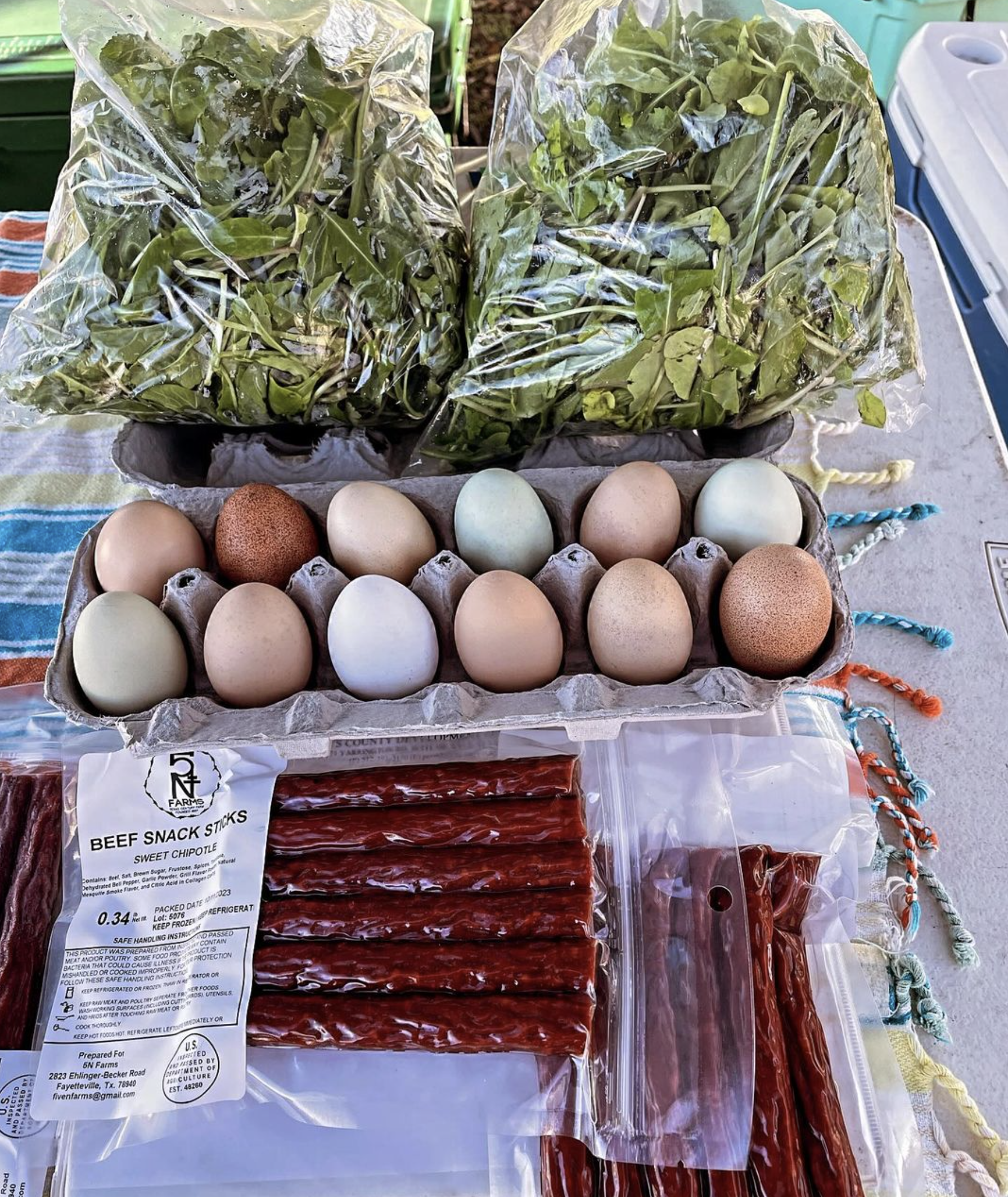
The protein selection at farmers markets in Central Texas goes well beyond what most people expect. Central Texas ranching country produces exceptional pasture-raised beef, pork, and chicken from small operations where the animals are raised on land you can actually drive to. Vendors at markets across the region sell cuts you won’t find at any grocery store — whole chickens from birds that spent their lives on grass, heritage-breed pork from small farms, grass-fed and grass-finished beef from ranches in the Hill Country and surrounding counties. If you care about where your meat comes from, this is the direct line.
Perhaps the biggest surprise for newcomers to farmers markets in Central Texas: fresh Gulf seafood. Several vendors make regular runs to the Texas Gulf Coast — Corpus Christi, Port Aransas, Rockport — and bring back shrimp, fish, and shellfish that were in the water days, not weeks, before they reach the market table. For a landlocked region 200 miles from the coast, the quality and freshness available at the right market on the right Saturday is genuinely remarkable. Ask which markets currently carry Gulf seafood vendors, as availability shifts by season and vendor schedule.
The German baking tradition is still alive, particularly in the Hill Country markets. Sourdough loaves, rye bread, strudel, and yes — kolaches — show up at markets in Boerne, Fredericksburg, and New Braunfels in forms that connect directly to the families who brought those recipes to Texas in the 1840s.
- Come early at the Hill Country markets. The peaches, the best bread, and the vendor conversations all happen in the first hour. Show up at 9:30 for a 9:00 market and you’ll still have a good time. Show up at 11:45 and you’ll be shopping the leftovers.
- Bring cash and a cooler. Most vendors take cards now, but cash still speeds things up. A small cooler in the car means your honey, eggs, and produce ride home without a problem.
- Dogs are almost always welcome, leashed. It’s part of the culture. Don’t let the lack of an explicit sign deter you.
- Ask where the farm is. The vendors at these markets are not brokers — they grew or made what they’re selling. Asking “where’s your farm?” is the start of a real conversation, and you’ll leave knowing something most people in your city don’t.
- Peach season is not long. Hill Country peaches run roughly May through August, peaking in June and July. If someone offers you a Fredericksburg Redskin or a Harvester variety from Gillespie County, buy a box. You’ll understand the region differently on the drive home.
- Ask about Gulf seafood vendors. Several markets carry vendors who make regular runs to the Texas coast. Availability shifts by season and vendor schedule — ask market staff or check the market’s Facebook page before making the trip specifically for seafood. When it’s there, it’s worth it.
- The meat vendors sell out too. Pasture-raised beef, heritage pork, and farm-raised chicken move fast at well-attended markets. If a specific cut or vendor is on your list, arrive in the first 30 minutes.
- The Wimberley Market Days is a separate category. It runs the first Saturday of the month at the old Lions Field — hundreds of vendors, craft and artisan focused rather than produce-focused. Plan two to three hours and wear comfortable shoes.
The “Lokal” Tradition — Why This Region Eats the Way It Does
In 1845 and 1846, two waves of German immigrants arrived in Central Texas under the Adelsverein — the Society for the Protection of German Immigrants in Texas. They settled what would become Fredericksburg, New Braunfels, Boerne, and a dozen smaller communities across the Hill Country. They were farmers, craftsmen, and intellectuals. They planted orchards in limestone country that Comanche riders had used for centuries. They built stone houses and stone fences and stone smokehouses that are still standing.
The word lokal, in the German they spoke, meant the neighborhood place — the gathering spot, the pub, the community hall. It carried with it a sense of rootedness, of belonging to a specific place rather than passing through it. That sense didn’t disappear when English replaced German as the primary language of these communities. It went underground. It lived in the recipes and the orchards and the way certain families still make sausage on Thanksgiving.
When you shop at farmers markets in Central Texas — in Boerne or Fredericksburg or New Braunfels — you’re participating in something that predates the zip code, the HOA, and the chain grocery store. That’s not nostalgia talking. It’s just what the land here has always meant to the people who stayed close to it.
Frequently Asked Questions
What day are most farmers markets in Central Texas held?
Saturday is the primary market day across the region, with the largest selection of vendors and the widest geographic coverage. Tuesday and Wednesday markets exist in several communities — Boerne, Pflugerville, Dripping Springs, and San Marcos — and are genuinely useful for remote workers and those who want a mid-week option without the weekend crowds.
Are farmers markets in Central Texas open year-round?
Many operate year-round, including New Braunfels, Budaful in Buda, and the Bell District market in Cedar Park. Some Hill Country markets — including Fredericksburg’s Thursday market — run seasonally. Always confirm hours with the individual market before making a special trip, especially in January and February.
When is Hill Country peach season?
Roughly May through August, with the peak window in June and July. Gillespie County (Fredericksburg) is the epicenter of Texas peach production. If you’re in the area during peak season, the Fredericksburg Farmers Market and several roadside stands along Highway 87 and FM 1376 are your best sources for varieties you won’t find at any grocery store.
What is the Wimberley Market Days?
Wimberley Market Days runs on the first Saturday of each month at the old Lions Field in Wimberley — one of the longest-running outdoor markets in Texas. It’s more arts, crafts, and artisan-focused than a traditional produce farmers market, with hundreds of vendors. Plan two to three hours and go early. It’s a completely different experience from the weekly farmers markets listed above and worth a separate trip.
Can I bring my dog to farmers markets in Central Texas?
Generally yes — leashed dogs are welcome at most outdoor markets in the region. It’s embedded in the culture here. The Herff Farm market in Boerne, set on a nature preserve property, is a particularly dog-friendly environment. When in doubt, check the specific market’s Facebook page, but a well-behaved dog on a leash is rarely unwelcome.
Do farmers markets in Central Texas sell meat and seafood?
Yes — this surprises many newcomers. Most well-established markets carry vendors selling pasture-raised beef, heritage pork, and farm-raised chicken from local ranches. Several also carry vendors who make regular runs to the Texas Gulf Coast with fresh shrimp, fish, and shellfish. Availability shifts by season and vendor, so check individual market social pages before making a trip specifically for proteins.
- Go Texan — Texas Department of Agriculture: Certifies locally grown and made Texas products. Many vendors at farmers markets in Central Texas carry the Go Texan seal.
- Texas Farmers Market: Operator of several markets in the region, including the Bell District location in Cedar Park. Publishes vendor directories and seasonal produce guides.
- Texas Department of Agriculture — Organic Certification: For shoppers looking specifically for certified organic vendors at Texas farmers markets.
Find Your Community in Central Texas
Every town on this list has a community guide on TexasHomeTalk — neighborhoods, schools, cost of living, and what it’s actually like to live there.