
The Ultimate Central Texas Rodeo Guide: Austin, San Antonio & the Hill Country Circuit
Season 1 · Episode 16 Hosts: Tyler Brooks & Maddie LawsonAlso Available On
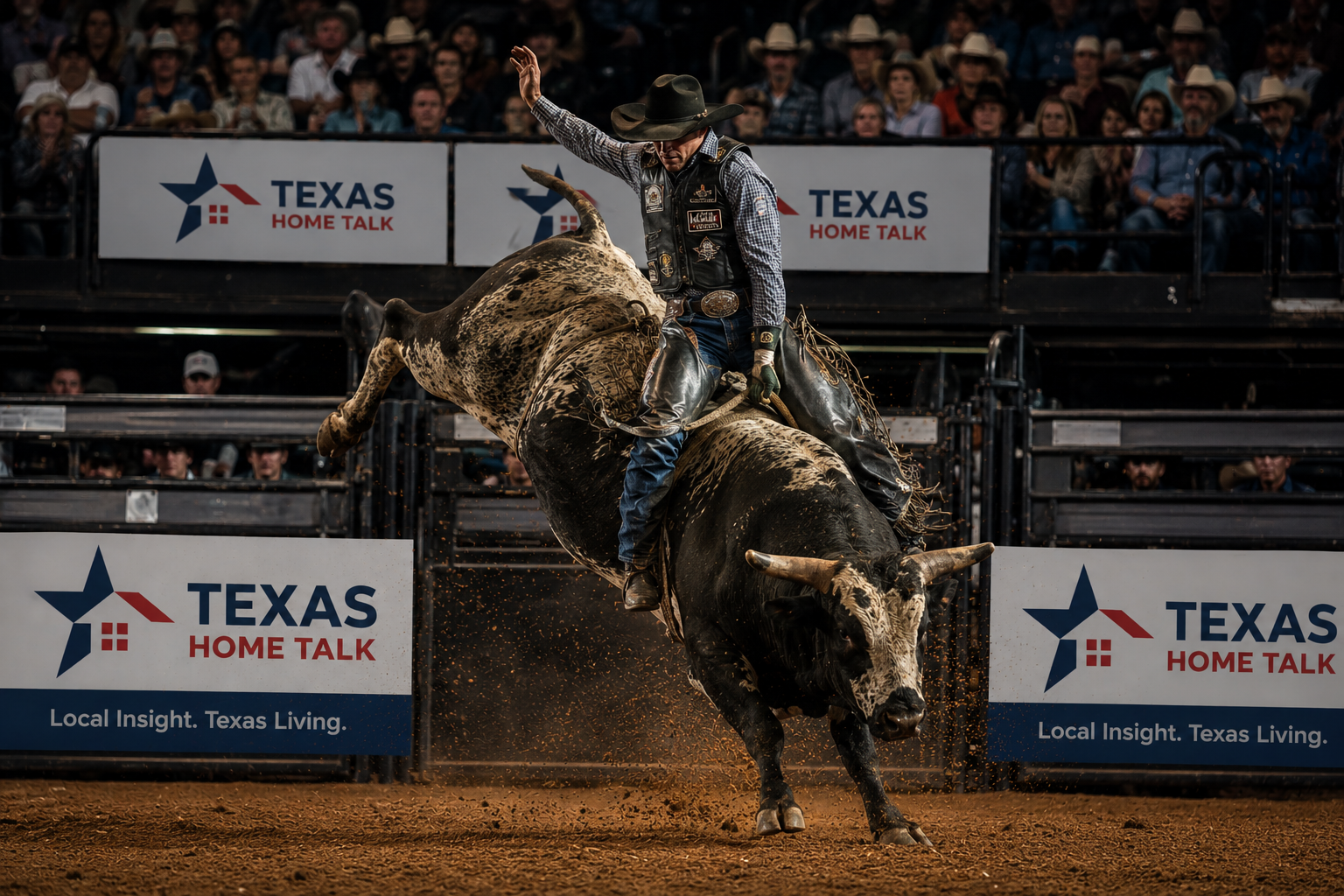
Central Texas rodeo runs on two calendars at once. Winter and spring belong to the big PRCA-sanctioned indoor arenas, San Antonio in February and Rodeo Austin in March, where purses and world-standings points are highest. Summer pushes the sport outdoors to community grounds in Liberty Hill, Taylor, Bastrop and Wimberley, where open-format entry and sunrise slack rounds decide winners. Fall closes in Elgin and Seguin.
About This Episode
Tyler and Maddie map the rodeo circuit across a region that stretches from Georgetown down to Converse, west into the hills at Fredericksburg, and east to Bastrop. The through-line is not a list of dates. It is the question of how two completely different versions of the same sport survive in the same region in the same month.
In early August you can sit in the air conditioning at the H-E-B Center in Cedar Park watching high-definition instant replays. A few weeks later and an hour west, you can stand in the dust at the Gillespie County Fairgrounds in Fredericksburg holding a pari-mutuel betting slip at a fairground track that has been running since 1881. Both are thriving. The episode argues that this is not an accident of scheduling but a real statement about what Central Texas audiences want from Western sports.
The back half turns to money and land. Rodeos here function as the funding mechanism for youth agricultural scholarships, veterans organizations and hyper-local historical preservation. They also sit on dirt that is now worth a great deal to developers along one of the fastest-growing corridors in the country.
What You'll Learn
Why the animal is scored as an athlete
In roughstock events a perfect score is 100 points, and up to half of it belongs to the bull or bronc. Two judges score the animal on power, agility and bucking action, and the competitor on control, rhythm and spurring technique. Draw a flat animal and the ceiling drops no matter how well you ride.
What slack actually is
Summer rodeos routinely take far more entries than an evening performance can hold. The overflow runs in slack: no announcer, no crowd, no funnel cakes, often at eight in the morning. Slack times combine with performance times to decide the winner, which means the champion may never have ridden under the lights.
Bracket format versus open format
Rodeo Austin runs a bracket tournament where a single bad draw ends your week. Taylor runs CPRA and UPRA open format, where non-members can enter on a permit and a weekend competitor can end up in the same performance as a seasoned pro.
Pari-mutuel racing at a county fair
Fredericksburg's Gillespie County Fair runs live pari-mutuel horse racing alongside the rodeo. You are not betting against a house. You are betting against the grandstand.
Why the real threat is a bulldozer, not attendance
Attendance is not the problem for these outdoor arenas. Land value is. Subdivisions are reaching the fence lines at Liberty Hill and Taylor, and the economics of keeping a dirt patch intact get harder every year.
Episode Sponsors
A sixth-generation Texan and Central Texas Hill Country native, Yvonne has been helping buyers and sellers reach their real estate goals since 2001. Expert negotiation, deep local market knowledge, and the trust of generations of clients who keep sending friends and family her way. Buying your first home, relocating to the Hill Country, or preparing to sell — call 830-626-8900.
TREC License #484207 Visit Central Texas LivingWith 33 years of lending through every kind of market, Steve has learned the job isn't selling you a loan. It's getting you to the closing table on time with no surprises. Moving to the Hill Country, moving out, or buying your next place in Central Texas — get started at homequalify.ai.
Steve Tomaselli NMLS #358920 · Edge Home Finance Corporation NMLS #891464 · Equal Housing Opportunity Visit homequalify.aiEpisode Chapters
- 00:00Episode Sponsor Introduction
- 00:45Welcome to the Circuit: From Georgetown to Converse
- 02:30The Big Leagues: Winter, Spring, and the PRCA
- 05:15The Code of the Dirt: How Scoring and Brackets Work
- 08:45The Summer Ground: Slack, Open Formats, and Local Legends
- 13:20The Ultimate Contrast: Air Conditioning vs. Pari-Mutuel Racing
- 16:40Protecting Hyper-Local Identity & The Urban Expansion Threat
- 20:15Episode Sponsor Conclusion
"The greatest threat to these historical outdoor community rodeos isn't a lack of fan interest. It is rapid urbanization."
Episode 16 · The Texas CurrentFrequently Asked Questions
When is Central Texas rodeo season?
Central Texas rodeo runs nearly year-round, but it splits into two seasons. Winter and spring bring the large PRCA-sanctioned indoor events: the San Antonio Stock Show & Rodeo across 18 days in February and Rodeo Austin at the Travis County Expo Center in March. Summer moves the sport outdoors to community grounds in Liberty Hill, Taylor, Bastrop and Wimberley, then closes in the fall with Elgin in September and the Guadalupe County Fair & PRCA Rodeo in Seguin in October.
What is slack at a rodeo?
Slack is the overflow qualifying round. A summer rodeo may draw far more entries than an evening performance can showcase, so the remaining competitors run in a stripped-down session, often early morning or a weekday afternoon, with no announcer, no crowd and no concessions. Slack times are combined with the performance times to determine the winner, which means a competitor can win the whole rodeo without ever riding under the lights.
Why does the animal get half the score in bull riding?
In roughstock events, bull riding, bareback riding and saddle bronc, a perfect score is 100 points and the animal is judged as an athlete alongside the rider. Two judges each award up to 25 points to the animal for power, agility and bucking action, and up to 25 points to the competitor for control, rhythm and spurring technique. A rider who draws a flat, uncooperative animal is mathematically capped no matter how cleanly the ride is executed.
Which Central Texas rodeo has pari-mutuel horse racing?
The Gillespie County Fair in Fredericksburg runs live pari-mutuel horse racing alongside its rodeo and fair events. Pari-mutuel means mutual stake: wagers go into a shared pool, the track takes an administrative cut, and the remainder is divided among the winning tickets. Bettors are competing against each other rather than against a house edge. The fair, founded in 1881, bills itself as the oldest continuous county fair in Texas.
Rodeo Towns in Our Coverage Area
Read the Full Episode Transcript
Verbatim transcript. Clear speech-to-text spelling artifacts have been corrected; the hosts' wording and substance are unchanged. Where the hosts' on-air statements differ from verified primary sources, the corrected facts appear in the article copy above, not here.
Sponsor read: This episode is brought to you by Yvonne Hoffmann, Realtor. A sixth-generation Texan and Central Texas Hill Country native, Yvonne has been helping buyers and sellers achieve their real estate goals since 2001. Known for her truly Texan star service, expert negotiation skills, and deep local market knowledge, she's earned the trust of generations of clients who continue to send their friends and family her way. Whether you're buying your first home, relocating to the Hill Country, or preparing to sell, Yvonne is ready to help. Give her a call today at 830-626-8900 and put her experience to work for you.
Tyler: Hey Maddie.
Maddie: Hi, Tyler.
Tyler: Welcome to the Texas Current Podcast. Today we are handing you a completely comprehensive guide to rodeos across central Texas and the Hill Country.
Maddie: Right. And geographically, we're really casting a wide net here. We're looking at an area stretching from, you know, Georgetown down to Converse. And then pushing west out into the hills of Fredericksburg and all the way east over to Bastrop.
Tyler: Yeah, but I mean we really want to make it clear that this isn't just like a list of dates. We're doing a full exploration of the source material on this region's distinct Western traditions.
Maddie: Exactly. Because this circuit, it's really a fight for the soul of Texas culture.
Tyler: It really is. And I want to set the scene for you as a listener, right? Imagine you're standing in the middle of Texas and it's mid-August.
Maddie: Oh, brutally hot.
Tyler: Right. The temperature is hovering right around like 105 degrees. And in one town, you are sitting in a crisp, beautifully air-conditioned arena watching high-definition instant replays of a bull ride.
Maddie: Sounds pretty nice.
Tyler: It does. But then, literally, just a few miles away, you could be covered in dust, holding a pari-mutuel betting slip at an outdoor dirt track that literally has not changed its footprint in a century.
Maddie: It's wild that those two things exist at the exact same time.
Tyler: Yeah, and that's the mission today. We are showing you how those two realities coexist. But to truly understand the mechanics of this culture, you know, we kind of have to follow the calendar, right?
Maddie: We do, yeah. Because the sport operates on its own very specific economic and environmental rhythms. You really have to start early in the year.
Tyler: Right, like winter and spring.
Maddie: Exactly. That's when the arenas are grand, the weather is actually cool, and the financial stakes are just at the absolute high.
Tyler: I want to focus on that financial aspect for a second. Right. Because early in the year, that means we are talking about the premier PRCA events. Right. And for anyone unfamiliar, the PRCA is the Professional Rodeo Cowboys Association. So think of it as the NFL of rodeo.
Maddie: That's a perfect analogy, yeah. And you also have the WPRA, which is the Women's Professional Rodeo Association, and they govern events like barrel racing.
Tyler: Right. So these early tournaments, these are the big leagues. And that brings us directly to the San Antonio Stock Show and Rodeo, which hits in mid to late February.
Maddie: Oh, it's a huge deal. 18 days at the Frost Bank Center and the Freeman Coliseum. San Antonio is universally recognized as one of North America's premier indoor rodeos.
Tyler: Yeah, and the logistics of pulling that off are just insane.
Maddie: It really is an incredible logistical machine. I mean, they literally truck in thousands of tons of specialized dirt to cover the arena floor.
Tyler: Wait, they bring in their own dirt?
Maddie: Oh, absolutely. And they meticulously pack it to ensure it has the exact right moisture content.
Tyler: Just for traction.
Maddie: Yeah. So the animals have traction and the riders have a safe landing. It has to be perfect because you have world-class competitors flying in for this.
Tyler: Because the payout is so significant, right?
Maddie: Exactly. A win here can dictate their entire professional year.
Tyler: So let's explain how the scoring actually works at a premier event like San Antonio. Because I feel like people just assume it's about hanging on for dear life.
Maddie: Right, like a mechanical bull at a bar or something.
Tyler: Exactly. But it's way more complex. You have two main categories. You've got roughstock events, so that's your bareback riding, saddle bronc, and bull riding. And they have timed events, which are things like steer wrestling and team roping. But in roughstock, the rider isn't the only athlete being judged.
Maddie: No. And that is a crucial distinction to make. In a roughstock event, a perfect score is a hundred points. But up to 50 of those points belong exclusively to the animal.
Tyler: Which is just wild to think about.
Maddie: It is. The judges are scoring the bull or the bronc on its power, its agility, its bucking action. And then the other 50 points are awarded to the cowboy for their control, their rhythm, their spurring technique.
Tyler: So if a cowboy draws a lazy bull, he cannot mathematically get a high score.
Maddie: It doesn't matter how flawlessly he rides.
Tyler: Man, that introduces this element of pure luck into the sport. Or fate, maybe. It's basically a lottery.
Maddie: It really is a lottery.
Tyler: And the stakes of that lottery become incredibly clear when the circuit moves slightly north up I-35 in mid-March, right? For Rodeo Austin.
Maddie: Yes, down at the Travis County Expo Center.
Tyler: Yeah, famously using the tagline Where Weird Meets Western, which is a great tagline, by the way. But the sport's format here is what really catches my attention because Rodeo Austin uses a bracket style tournament.
Maddie: Right. Which completely changes the dynamic.
Tyler: Yeah. I mean, when I hear bracket, I immediately think of March Madness, you know? Which happens around the exact same time of year anyway.
Maddie: The psychological pressure of Rodeo Austin's bracket is honestly nearly identical to the NCAA basketball tournament.
Tyler: How so?
Maddie: Well, in a traditional open rodeo, a rider might have a pretty mediocre Thursday night ride, right? But if they come back and have an incredible Saturday night, their aggregate score over the weekend might still win them the prize money. A bracket system eliminates that safety net entirely.
Tyler: It's just head-to-head survival. So if you are a top-seeded cowboy, like the equivalent of a number one seed in basketball, and you happen to draw an erratic, unpredictable bull, which is like a scrappy mid-major team that just gets hot from the three-point line, you could literally get knocked out in the first round.
Maddie: Precisely. You either execute your ride or you pack up your trailer and drive home. Every single eight-second ride is a sudden death scenario. And the crowd, they understand that math. The tension in the arena is palpable because there is literally no tomorrow for the loser.
Tyler: That's intense. But you know, the bracket is really only half the story of Austin, right?
Maddie: Oh, absolutely. Rodeo Austin was founded in 1938, and it operates as this vast economic engine. It's actually one of Texas's leading youth scholarship organizations.
Tyler: Yeah, I was reading up on the mechanics of these scholarships in the source material, and it's fascinating. It's not just some corporation writing a check.
Maddie: No, not at all.
Tyler: It's driven by the youth livestock auction. So you have these teenagers who spend an entire year raising a steer or a lamb.
Maddie: Right. They learn the biology of the animal, they manage the feed economics.
Tyler: Exactly. And then they bring it to the rodeo, and local businesses and syndicates actually bid on that animal. I mean, a grand champion steer can sell for six figures. And that money directly funds the student's college education.
Maddie: It's an amazing, self-sustaining, localized economy. You have millions of dollars raised at events like BBQ Austin, which kind of kicks off the festival, and the ticket sales from the PRCA bracket. And all of that ultimately fuels agricultural education for the next generation. It really disguises a vast philanthropic endeavor inside this high adrenaline sporting event.
Tyler: That's a great way to put it. So, okay, the winter and spring are defined by these elite athletes, multi-million dollar economies, and indoor coliseums. But what happens to the Texas circuit when the summer heat rolls in? Because I mean the elite PRCA riders often pack up and chase the big money out of state where the weather's cooler.
Maddie: They do. And the entire economic model of the circuit just flips. We move away from the grand indoor arenas and transition into these classic outdoor community grounds.
Tyler: So this is like the minor leagues, the proving ground.
Maddie: Exactly. Let's look at the Liberty Hill Pro Rodeo in mid-May, for example.
Tyler: Okay, set the scene for us there.
Maddie: So the Liberty Hill arena is your quintessential outdoor hill country venue. But when you transition from the elite winter rodeos to these community summer rodeos, you encounter a very specific logistical challenge.
Tyler: Well, you're talking about slack.
Maddie: Yes, slack.
Tyler: I saw slack events listed on almost every single summer rodeo schedule we looked at, and I was so confused. How does the math of slack actually work?
Maddie: It basically comes down to capacity. So let's say Liberty Hill has 150 barrel racers registered to compete. But the primetime evening performance, the one the fans buy tickets for, it only has the bandwidth to showcase about 15 of them.
Tyler: Right, because you can't have people sitting there for 10 hours.
Maddie: Exactly. But you still have to give the other 135 racers their turn, right? So the rodeo holds slack runs. This is usually at like eight in the morning or early afternoon on a weekday.
Tyler: Oh wow. So there's no bright lights, no announcers hyping up the crowd, no funnel cakes.
Maddie: None of it. It is entirely stripped down. It's literally just the competitor, their horse, the electronic timers, and the judges.
Tyler: That's kind of awesome, actually.
Maddie: It is pure unvarnished competition. And all of the times from the morning slack are combined with the times from the evening performance to determine the ultimate winner.
Tyler: Got it. And then once the sun finally sets and the heat breaks, the lights come on at Liberty Hill, and the venue transforms into this huge family festival with food trucks and, of course, mutton bustin'.
Maddie: Oh, mutton bustin'.
Tyler: Which is objectively the greatest halftime show in sports.
Maddie: It really is.
Tyler: For the uninitiated, they put a helmet on a five-year-old child, place them on the back of a sheep, and just see how far they can ride across the dirt before tumbling off.
Maddie: It is pure chaos.
Tyler: Total chaos. But okay, let's stay focused on the adult competitors for a second. By mid-July, we hit the Taylor Pro Rodeo at the Williamson County Expo Center. And my notes show they use an open format sanctioned by the CPRA and UPRA. Can you decode those acronyms for us? Because that sounds like a very different ecosystem than the restricted PRCA bracket we just talked about in Austin.
Maddie: Oh, it is a completely different ecosystem. So the CPRA is the Cowboys Professional Rodeo Association, and the UPRA is the United Professional Rodeo Association. These are regional open format sanctioning bodies. In Austin's PRCA bracket, you generally have to be highly ranked in the world standings just to secure an invitation.
Tyler: Right. It's exclusive.
Maddie: Very. But the open format in Taylor is deeply democratic.
Tyler: Meaning literally anyone can enter.
Maddie: Pretty much. As long as you pay your entry fee, yes. So you have rising Texas competitors, you have weekend warriors who work construction Monday through Friday. And young talent all riding right alongside seasoned veterans.
Tyler: Man, that's like the equivalent of a minor league baseball player suddenly getting a chance to step into the batter's box against a major league pitcher in a real sanctioned game.
Maddie: That's exactly what it's like. And if you pull off an upset, you instantly put your name on the map. You earn your stripes in the dirt at Taylor. And what makes Taylor specifically fascinating is how they pair that gritty rising star competition with profound historical recognition.
Tyler: Right. They celebrate the legacy of Bill Pickett. Who is a hometown hero there. And he essentially invented the sport of bulldogging, which we know today as steer wrestling.
Maddie: Right. And his original technique was just unbelievable.
Tyler: Unbelievable is one word for it. The history books say he would ride alongside a steer, jump off his horse, grab the steer by the horns. And here is the crazy part.
Maddie: Yeah. To get it to the ground, he would literally bite the animal's upper lip.
Tyler: It's so wild to picture.
Maddie: He learned the technique from watching bulldog cattle dogs. Obviously, modern steer wrestlers use leverage rather than biting, but I mean Pickett's innovation is the absolute foundation of the modern timed event.
Tyler: It is, and that historical connection is vital for the town. But Taylor also bridges that history with the future by partnering with the Austin Gamblers, you know, the professional bull riding team.
Maddie: Oh, right, for their special Next Gambler events.
Tyler: Exactly. Professional scouts are literally sitting in the stands at the Williamson County Expo Center, actively looking for the next national star.
Maddie: Which keeps the local crowds deeply invested, I'm sure. And speaking of community investment, as we roll into late July and early August, we hit the Bastrop Homecoming and Rodeo at Mayfest Hill Park.
Tyler: Yeah, and notice they don't just call it a rodeo, they explicitly call it a homecoming.
Maddie: Right. There are parades down Main Street, community dances, horseshoe tournaments. It's a whole thing. Bastrop perfectly illustrates the economic reality of the summer circuit. Just like that multi-million dollar scholarship engine we saw in Austin, Bastrop's proceeds specifically fund local scholarships and agricultural initiatives. On a hyperlocal level, these rodeos act as the lifeblood of the town's social infrastructure. They're economic engines that sustain local programs year-round, entirely funded by a single weekend of flying dust.
Tyler: But man, as we hit August, that dust is brutally hot.
Maddie: Oh, absolutely punishing.
Tyler: We are talking about the absolute peak of the Texas summer, where just standing still makes you sweat through your shirt. The environment practically forces the sport to adapt. And it creates the starkest contrast on the entire calendar. In the exact same month, you have two radically different ways to experience rodeo. So let's start with the Cedar Park Pro Rodeo in early August.
Maddie: Okay, so Cedar Park is held indoors at the H-E-B Center, and it is a thoroughly modern, highly polished production.
Tyler: The operative word there being indoors. You walk out of the blinding hundred-degree heat into a concourse that is beautifully air conditioned. I mean, it literally feels like stepping into a professional hockey arena, which, well, it is.
Maddie: Exactly, it is a hockey arena. And they have extensive video boards offering high-definition instant replays. The sound system is pumping out heavy bass, and the entertainment lineup is totally cutting edge.
Tyler: Yeah, we're talking about frisbee dog acts, professional stand-up comedy routines right there in the dirt, and these elaborate laser light shows.
Maddie: It caters directly to a suburban modern audience, doesn't it?
Tyler: It really does. They want the adrenaline and the athletic thrill of Western sports, but they want it packaged with the comforts and the high production value of a major arena rock concert.
Maddie: And then literally a few weeks later, in late August, you drive an hour west to Fredericksburg for the Gillespie County Fair and Rodeo. And the contrast is just jarring. You trade that arena rock concert for an unplugged acoustic folk festival.
Tyler: That is an incredibly accurate comparison. The Gillespie County Fair is the oldest continuous county fair in Texas. And it is entirely outdoor. You are out there in the elements, smelling the livestock and the funnel cakes. It is deeply steeped in Fredericksburg's unique German agricultural heritage. But the mechanical difference that truly separates Fredericksburg is the pari-mutuel horse racing they hold right alongside the rodeo events.
Maddie: Let's break down pari-mutuel racing for a second, because I think a lot of people, myself included, before we started researching this, assume it works kind of like a casino, right? Or you're betting against the house. And the house always has the edge. But that's not how pari-mutuel works at a county fair, is it?
Tyler: No, it's fundamentally different. Pari-mutuel literally means mutual stake. So when you place a bet at Fredericksburg, you aren't betting against the track. You are betting against the other people sitting in the grandstand with you. All the money wagered goes into a giant pool. The track takes a small administrative cut, and the rest of the pool is divided among the winning tickets.
Maddie: So if you bet on a long-shot horse and it happens to win, you get a massive, well, highly significant payout.
Tyler: Exactly, because very few people in the stands share that winning pool with you.
Maddie: It creates this intense localized rivalry among the fans, doesn't it?
Tyler: It really does. You are literally trying to outsmart your neighbors.
Maddie: That is so cool. Okay. But taking a step back, look at the dichotomy here. You have the polished, air-conditioned spectacle of Cedar Park, and then the traditional dirt track pari-mutuel racing of Fredericksburg. Both thriving in the same region in the exact same month. What does the survival of both styles tell us about the modern rodeo fan?
Tyler: I think it proves that rodeo fans do not want a monolithic experience. They contain multitudes, you know, they crave the cutting-edge entertainment of the 21st century, sure. But they also have a deep psychological need for authentic heritage. Sometimes you want the air conditioning and the instant replays. But other times you need to feel the rumble of the horses through the wooden bleachers and connect with an agricultural tradition that has survived uninterrupted for generations. The regional economy is robust enough to support both ends of that spectrum.
Maddie: That's a great point. And I want to push out past that core I-35 corridor now. Because if we look just outside the primary footprint, say, within an hour's drive of Austin or San Antonio, we see surrounding towns using these events to fiercely protect their hyper-local identities.
Tyler: Yes. It's not just generic cowboy culture out there.
Maddie: Exactly. It is explicitly tailored to the town's zip code. Take the Lockhart Chisholm Trail rodeo in June.
Tyler: Right. Lockhart actively uses its rodeo to preserve the mechanics of the Chisholm Trail. In the late 1800s, millions of cattle were driven from Texas up to the railheads in Kansas.
Maddie: And that trail came right through Lockhart.
Tyler: Exactly. So today, their rodeo isn't just about bucking horses, it's a living history lesson. They host parades, they showcase authentic trail riding gear, and naturally they serve incredible barbecue.
Maddie: Because Lockhart is the barbecue capital of Texas.
Tyler: Right. They are utilizing the rodeo format to teach the next generation about the actual cattle drives that shaped their local economy.
Maddie: And then in September, you have the Elgin Pro Rodeo. And Elgin leans incredibly hard into its specific identity as the sausage capital of Texas.
Tyler: They do. But I mean I have to play devil's advocate here for a second. Are these hyperlocal focuses, like slapping Chisholm Trail on a poster in Lockhart or leaning into sausage in Elgin, are they just clever marketing gimmicks to sell more tickets and concession stand food?
Maddie: You know, that is a fair critique to raise, but from looking at the source material, the reality is much deeper than marketing. These are living acts of preservation.
Tyler: How so?
Maddie: Well, history, if it isn't ritualized and repeated, just becomes an abstraction. It fades into a textbook. If you don't actively celebrate the German agricultural roots in Fredericksburg, or the specific sausage making techniques brought over by immigrants in Elgin, that nuanced history just disappears. The rodeo serves as a cultural vessel. It forces the community to gather once a year and tangibly reenact their heritage. It prevents the hill country from turning into one generic, uniform suburb.
Tyler: That makes perfect sense. The rodeo is essentially the anchor that prevents the town from drifting away from its roots.
Maddie: Exactly.
Tyler: And we see that community anchoring in other very practical ways too. Look at the Wimberley VFW rodeo, which happens over the 4th of July weekend.
Maddie: The community impact in Wimberley is profoundly direct. This long-standing hill country tradition serves as a primary financial engine for VFW Post 6441. The mechanics of the event are entirely designed around supporting local veterans. The entire town, including local businesses that sponsor the chutes and the banners, rallies around the dirt arena to generate capital that goes straight back to the men and women who serve.
Tyler: Or the Guadalupe County Fair and Rodeo over in Seguin in October, which brilliantly integrates PRCA level competition with regional live music and agricultural showcases. And you absolutely cannot overlook the Blanco County Fair and Rodeo in August, which brings traditional livestock exhibits right to the forefront. Every single town adds a completely distinct ingredient to the recipe.
Maddie: They do. And when you synthesize all of these distinct ingredients, the pari-mutuel racing in Fredericksburg, the high-stakes scholarship brackets in Austin, the Chisholm Trail history in Lockhart, and the veteran funding in Wimberley, you realize the local rodeo calendar is not merely a sports schedule. It is a living, breathing map of Texas's evolving cultural identity.
Tyler: That's a beautiful way to put it. But you know, I want to leave you with a completely different thought to consider as someone exploring this culture.
Maddie: What's that?
Tyler: As we look to the future, the greatest threat to these historical outdoor community rodeos isn't a lack of fan interest. It is rapid urbanization.
Maddie: Urbanization, right.
Tyler: The I-35 corridor is one of the fastest growing regions in the country. Subdivisions and concrete sprawl are creeping right up to the wooden fences of places like Liberty Hill and Taylor.
Maddie: Wow. I didn't even think about that.
Tyler: Yeah, these dirt arenas sit on land that is suddenly worth millions of dollars to real estate developers. So the true tension over the next decade will be whether these towns can justify keeping their historic dirt patches intact, or if the economic pressure to pave over them will simply become too great.
Maddie: So the survival of the summer circuit is literally a fight against the bulldozer.
Tyler: It really is.
Maddie: That is a sobering reality. Every time a new subdivision goes up, the space for a horse to run gets just a little bit smaller. You are watching a tradition actively fight for its physical space on the map.
Tyler: Absolutely. Before we wrap up, we want to thank our sponsors for making this possible. It's time for you to look at the calendar, pick one of these incredibly resilient towns, and go experience the heat, the noise, and the tradition for yourself.
Maddie: Definitely. Get out there, buy a ticket, and support the riders and the local communities keeping this history alive.
Tyler: Thanks for listening, and we will see you out on the trail.
Sponsor read: This episode is brought to you by Steve Tomaselli, your Texas mortgage broker. With 33 years of lending through every kind of market, Steve has learned the job isn't selling you a loan. It's getting you to the closing table on time with no surprises. Whether you're moving to the Hill Country, moving out, or buying your next place in Central Texas, Steve will guide you through a smooth transaction. To get started, visit him at homequalify.ai. That's homequalify.ai. Steve Tomaselli, NMLS number 358920. Equal housing opportunity.
About this episode. Tyler Brooks and Maddie Lawson are AI-generated voices. The Texas Current is produced by Texas Home Talk using synthetic narration; the hosts are not real people and do not conduct interviews or attend events.
Sources. Factual claims in the article copy above were verified against primary sources before publication: the San Antonio Stock Show & Rodeo, Rodeo Austin, gillespiefair.com, hebcenter.com, libertyhillprorodeo.com, cprarodeo.com, bastrophomecomingrodeo.org, gcfair.org, chisholmtrailrodeo.com, vfw6441.com, the Texas State Historical Association, and Williamson County. Where the recorded conversation differs from a verified source, the verified figure governs the article copy; the transcript remains a record of what was said.
Sponsor disclosure. The sponsor cards above are paid placements. Sponsors have no involvement in, and no influence over, Texas Home Talk editorial content. Event listings, venues and dates are editorial and are not sponsored.